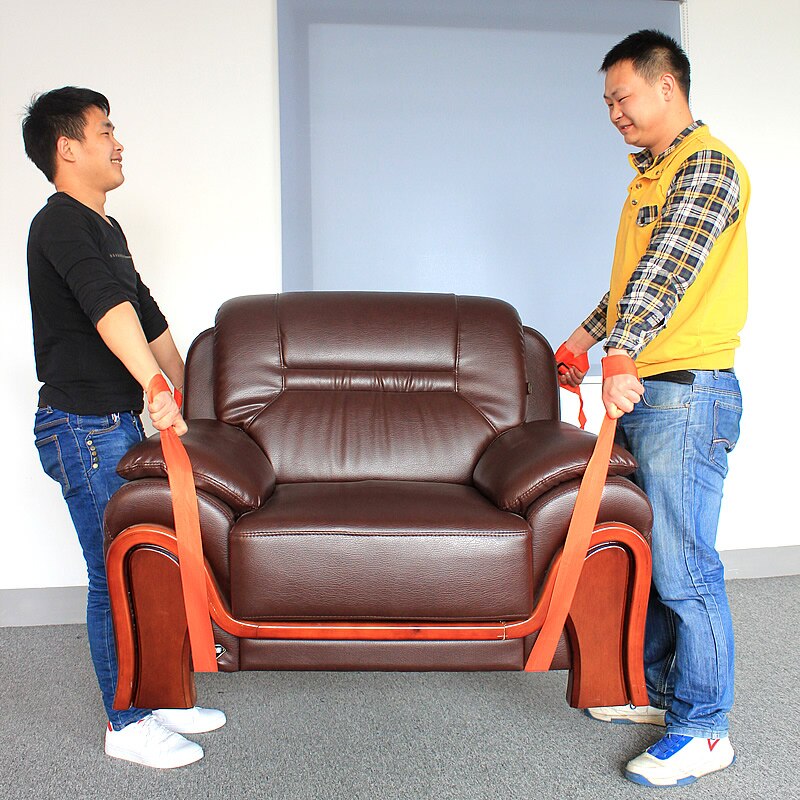
Using moving straps means looping straps around furniture, then across your forearms or shoulders. This lets you lift with your legs instead of your back. The straps spread weight and lower the item’s center of gravity, which lowers injury risk and makes stairs easier to manage.
What Are Moving Straps?
Moving straps are bands of webbing that loop around a heavy item and over your forearms or shoulders. They use leverage, so you lift more weight than you could with your arms alone.
The straps lower the item’s center of gravity, which cuts down on bending and twisting. Moving straps come in two main styles: forearm straps and shoulder straps.
They cost little to buy, and some truck rental companies rent them out too. If several friends are helping you move, you may want more than one set.
When Should You Use Moving Straps?
Moving straps work well for any heavy item you need to lift, though other tools suit some situations better. A dolly is often easier and safer when you can slide it under the item.
Stairs change that equation. If you need to carry an item down a staircase, moving straps make more sense than a dolly.
Moving straps also beat lifting with no tools at all. Carrying a couch without straps takes more energy and forces you to bend and twist in ways that can cause injury.
How Do You Use Moving Straps?
Follow these steps before and during the lift:
- Read the instructions included with your moving straps, so you know how to position them and lift properly.
- Measure the furniture and any doorways, halls, or staircases along your path, to confirm the item fits through. Remove doors from their hinges if you need more space.
- Place the straps on your forearms or across your chest and shoulders, depending on the type you use. Check the diagram in your instructions for proper placement, and adjust the straps so they don’t slip.
- Lay the strap on the floor in front of the item. Tip the item back and slide the strap under it. Repeat with a second strap if you’re using two.
- Center the strap under the middle of the item. With two straps, place one near the front edge and one near the back, then center the item over both.
- Learn the lifting technique for your strap type, forearm or shoulder, before you start, along with the injury risks involved.
- Work in tandem with your partner. Lift at the same time, then move together, with one person stepping forward and the other stepping back. Communicate as you go, and lower the item if either of you needs a break.
How Do You Move with Forearm Straps?
- Place a strap near the edge of the item. For items with legs, run the straps parallel along the inner side of the legs. For items without legs, cross the straps in an x pattern for added stability.
- Find the loop that lets you lift the item at least 5 inches off the ground, since forearm straps have several loops to choose from.
- Slide your forearms into the loops, keep your back straight, and bend your knees. Lift with your legs at the same time as your partner.
- Take small steps, with one person moving forward and the other moving back. Keep most of the weight on your legs.
- At your destination, lower the item together with your partner. Slip the straps off your forearms and out from under the item.
How Do You Move with Shoulder Straps?
- Position the harness over your shoulders, following the manufacturer’s instructions, with the bar facing front.
- Slide the lifting strap under the item and center it. Weave the strap up and over the bar on your harness, and have your partner do the same.
- Adjust the strap length so you can lift the item at least 5 inches off the ground, and so the item stays level once both of you stand. Tuck away any extra strap so you don’t trip.
- Bend your knees and place your hands in front of you on the side of the item. Push against it, and lift with your legs together with your partner, keeping your back straight.
- Move slowly, with one person stepping forward and the other stepping back. Use your hands to keep the item steady.
- At your destination, lower the item together with your partner. Remove the strap from your harness and slip it out from under the item.
What Works Better Than Moving Straps?
Professional movers bring experience and the right tools to lift and relocate heavy items safely. Alliance Relocation Services offers specialty moving services across the United States and Canada, working alongside the moving company that loads and drives the truck.
See From Heavy to Light: How to Handle and Move Your Piano or Heavy Furniture with Ease.
See How to Pack a Moving Container and How to Pack a Moving Pod Correctly: Tips from Alliance Relocation Services.
Fill out Alliance’s quote form to get an estimate, often back within minutes.
Frequently Asked Questions
Do I need two people to use moving straps?
Yes, moving straps work best with two people lifting and moving together. One partner steps forward while the other steps back, keeping the item level and stable.
Can moving straps replace a dolly?
A dolly works better when you can slide it under an item on flat ground. Moving straps make more sense on stairs or when no dolly is available.
What’s the difference between forearm and shoulder moving straps?
Forearm straps loop around your forearms through adjustable loops, while shoulder straps form a harness worn over your shoulders with a front bar. Both styles lower the item’s center of gravity and spread the weight across your body.
What specialty services does Alliance Relocation Services provide?
Alliance Relocation Services focuses on specialty services. These include custom crating, furniture disassembly and reassembly, appliance disconnect and reconnect, and unpacking. Insured, background-checked technicians handle this work at origin and destination.