Industrial crates protect equipment during shipping and storage by matching crate design to the item’s weight, shape, size, and fragility. Builders add foam lining, floater bases, or extra supports to guard against vibration and shock. Blocking, ramps, and specialty hardware help with loading or let the crate get reused later.
What Happens If a Crate Is Overdesigned or Underdesigned?
Overdesign raises costs through unnecessary hardware, excess lumber, and added labor. Underdesign risks damaged or destroyed equipment, and insurance might exclude the full loss. A damaged shipment can also disrupt business operations and add further costs.
What Is the PPP-B-601-A Design for Industrial Crates?
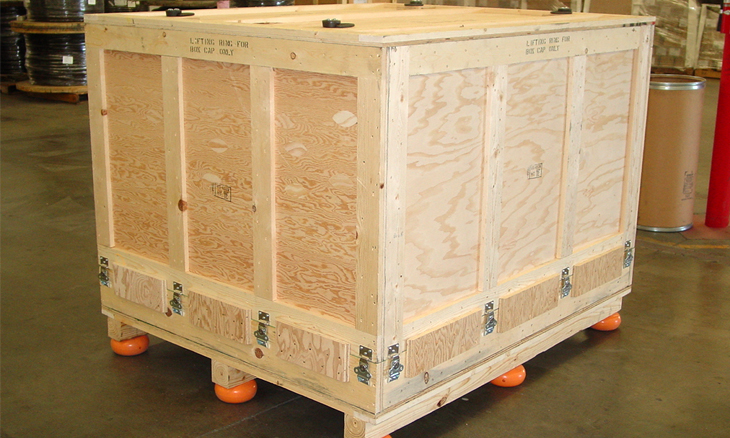
Most industrial crates follow the PPP-B-601-A design, a light-duty wooden shipping crate used for many purposes. Builders strengthen these crates with intermediate cleats, which are extra boards between the edge cleats. Thicker sheathing, usually plywood, forms the four panels and top for added strength.
When Do Crates Need a PPP-B-601-A D/E Design?
Crates use the PPP-B-601-A D/E design when top loading is difficult or impossible, or when equipment is very heavy or bulky. After securing equipment to the crate’s base, workers fit the cap, which includes two sides, two ends, and the top, then fasten it to the skids. The base may use solid lumber or plywood, depending on the equipment’s weight, size, and value.
Do You Need a Full Crate or Just a Pallet for Industrial Equipment?
A pallet or skid may suffice for some industrial equipment, though machines, medical devices, and other high-value items usually need more protection. Skids are wood supports under a base that let forklifts lift and move the load. Alliance Relocation Services offers custom crating and uncrating when equipment needs more protection than a pallet alone.
In some cases, a base with a cap or sleeve gives enough protection, while risers, removable supports, and rails ease loading and unloading. Most industrial equipment needs full protection from damage during transport or exposure to weather.
How Do Floater Bases Protect Equipment From Vibration and Shock?
Most industrial equipment and machines are highly sensitive to vibration and shock. A shock-absorbing floater base protects against this risk. This is a platform raised from the crate base by compressed material, typically polypropylene foam, polyethylene, or polyurethane.
Floater bases reduce the impact of vibration and shock. Crates may also include foam lining, or equipment may be braced or blocked with foam to reduce vertical and lateral shock.
Special labeling and indicator devices can show whether handlers managed the equipment correctly. An indicator device reveals if a tipping violation or shock occurred.
Why Choose Alliance Relocation Services for Industrial Crating?
Alliance Relocation Services has provided fast, reliable service for over 20 years. Alliance has the materials, production capacity, and a network of specialty vendors to handle large-scale orders, even on short notice.
Alliance uses precision engineering to meet shipping challenges and can work with 3D models to design crates for shipping and storage. Alliance is committed to making sure valuable equipment is shipped and stored safely and securely. Alliance designs and constructs its crates and cases to withstand the rigors of transportation while reducing the impact of harsh shipping environments.
For a closer look at planning a larger project, see Planning an Industrial Relocation. See also The Importance of Custom Crates for Specialty, Fragile Items: Trust the Right Team for a Safe Move.
Get a price quote for your industrial crating project. Call Alliance Relocation Services at 877-242-0409.
Frequently Asked Questions
How long has Alliance Relocation Services provided its service?
Alliance Relocation Services has provided fast, reliable service for over 20 years.
What materials cushion equipment inside a floater base?
A floater base typically uses compressed polypropylene foam, polyethylene, or polyurethane between the crate base and the raised platform.
What is the difference between a crate base and a skid?
A skid is the wood structure under a base that lets forklifts lift and move the load. A base supports the equipment itself.
Can Alliance Relocation Services use 3D models for crate design?
Yes. Alliance Relocation Services can work with 3D models to design and build crates for shipping and storage.